Building a startup is an exercise in resource management. You are juggling product development, hiring, and sales, often with a lean team. In this high-pressure environment, Search Engine Optimization (SEO) frequently falls to the bottom of the priority list.
Many founders view SEO as a “nice-to-have” or a task for “later.” However, waiting until your product is “perfect” to start ranking on Google is a strategic mistake. By the time you’re ready to scale, your competitors will have already claimed the digital high ground.
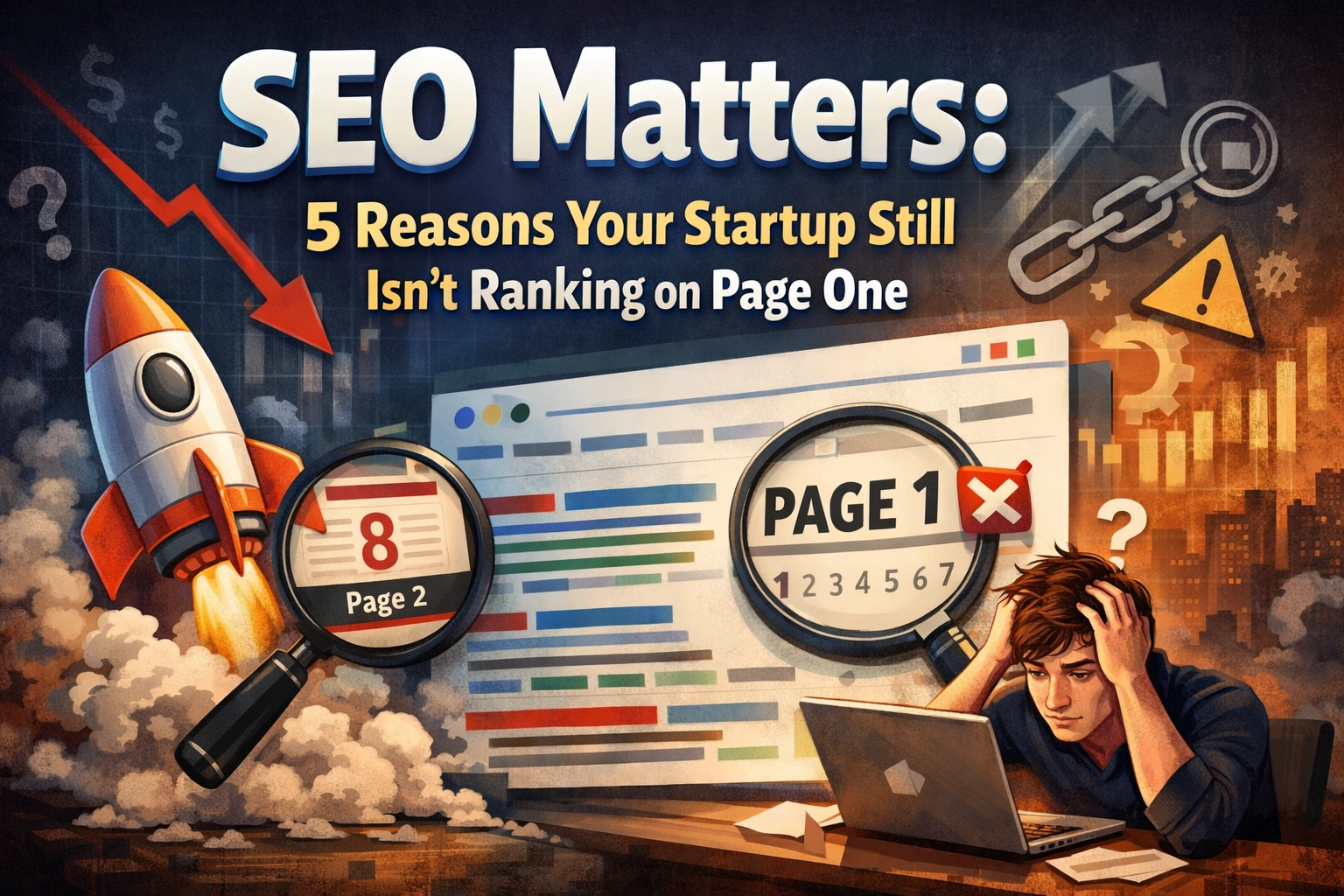
If you’ve launched your site but find yourself buried on page ten of the search results, you aren’t alone. Achieving visibility in 2026 requires more than just a few blog posts and a keyword list. It requires a foundational understanding of why your current strategy: or lack thereof: is failing to move the needle.
Here are the five primary reasons your startup isn’t ranking on page one and how you can pivot your strategy to see real results.
1. You’re Fighting Goliath with a Slingshot
One of the most common mistakes startups make is targeting broad, high-volume keywords right out of the gate. If you are a new Fintech startup, trying to rank for “banking app” or “investment software” is essentially impossible in the short term.
These terms are dominated by legacy institutions and established tech giants with massive domain authority and million-dollar SEO budgets. When you compete for these broad terms, your website gets lost in the noise.
The solution is to focus on long-tail, intent-rich keywords. These are longer, more specific phrases that potential customers search for when they are closer to a buying decision. Instead of “CRM software,” a better target might be “HubSpot automation for UK consulting firms.”

By narrowing your focus, you reduce competition and increase the relevance of your traffic. At Nepatech Solutions, we often see that targeted traffic from niche keywords converts at a much higher rate than generic visitors. Focus on solving specific problems for specific people.
2. Your Technical Foundation is Shaky
Google is no longer just a text-matching engine; it is an experience engine. If your website is slow, difficult to navigate on a phone, or plagued by technical errors, Google will penalize you.
Technical SEO is the digital “plumbing” of your site. If it leaks, nothing else matters. Startups often focus heavily on the aesthetic design of their website while ignoring the underlying performance metrics.
Key technical factors that could be holding you back include:
- Page Load Speed: In an era of instant gratification, a three-second delay can double your bounce rate. Slow sites signal to Google that you aren’t providing a good user experience.
- Mobile Optimization: With the majority of global traffic coming from mobile devices, a “mobile-first” approach is mandatory. If your menus are hard to click or your text is too small on a smartphone, you will struggle to rank.
- Security (HTTPS): A secure site is a basic requirement for trust. If your site isn’t using an SSL certificate, Google will flag it as “Not Secure,” driving away both users and ranking potential.

Addressing these issues early prevents “technical debt” from accumulating. For businesses looking to scale their operations, ensuring your tech stack is optimized is the first step toward visibility. You can learn more about how we handle these technical hurdles in our services section.
3. Content Quality vs. Content Quantity
There was a time when you could “game” the system by churning out hundreds of low-quality, keyword-stuffed articles. Those days are long gone. Google’s algorithms, particularly with recent AI-driven updates, are now incredibly sophisticated at identifying value.
Many startups make the mistake of publishing “thin” content: short, 500-word posts that provide no unique insight. If your blog looks like a collection of generic AI-generated filler, neither Google nor your customers will take you seriously.
Google rewards E-E-A-T: Experience, Expertise, Authoritativeness, and Trustworthiness. Your content needs to reflect deep industry knowledge and provide practical solutions to your audience’s pain points.
Instead of writing five mediocre posts a month, focus on writing one comprehensive, “pillar” piece of content that establishes your authority. Link this content back to your core offerings, such as your AI automation solutions, to create a cohesive narrative for the reader.
4. The Authority Gap (Backlinks)
You can have the best content in the world, but if nobody is talking about it, Google won’t trust it. Domain Authority (DA) is a metric that reflects how much “weight” your website carries in the eyes of search engines.
For a new startup, your DA starts at zero. To grow it, you need backlinks: links from other reputable websites pointing back to yours. Think of a backlink as a “vote of confidence.”
Building authority takes time, but it is essential. Common ways to build these links include:
- Guest posting on industry-specific blogs.
- Being featured in startup directories or news outlets.
- Creating original data or research that others want to cite.
Many founders overlook this because it requires manual outreach and networking. However, a site with high-quality content but zero backlinks will almost always be outranked by a site with average content and a strong backlink profile. It’s a marathon, not a sprint.
5. Overlooking On-Page Fundamentals
Sometimes, the reason you aren’t ranking isn’t a complex algorithmic mystery: it’s a lack of basic housekeeping. On-page SEO involves optimizing individual pages so that search engines understand exactly what they are about.

We frequently see startup sites where the “Title Tag” is simply “Home” or the “Meta Description” is left blank. These are missed opportunities to tell Google (and users) why they should click on your link.
Every page on your site should have:
- A Unique Title Tag: 50–60 characters that include your primary keyword.
- A Compelling Meta Description: A short summary that encourages clicks by highlighting the value proposition.
- Strategic Header Tags (H1, H2, H3): Use these to structure your content so it is easy to scan for both humans and bots.
- Internal Linking: Link to other relevant pages on your site, such as your blog, to help Google crawl your content more effectively.
The Role of AI in Modern SEO
In 2026, the landscape of SEO is shifting toward “Agentic AI” and conversational search. Users are no longer just typing keywords; they are asking complex questions.
Startups that ignore how AI interacts with search will find themselves obsolete. Your content needs to be structured in a way that AI models can easily parse and summarize. This means using clear headings, bulleted lists, and schema markup.
At Nepatech Solutions, we focus on helping businesses bridge the gap between traditional search and the new AI-driven reality. Our approach to AI automation isn’t just about internal efficiency; it’s about external visibility and staying ahead of the curve.
Why SEO is a Business Strategy, Not a Tech Task
Ultimately, SEO isn’t just about rankings; it’s about building a sustainable pipeline of customers. Relying solely on paid ads is a recipe for high overhead and low margins. Organic search provides a compounding return on investment that pays dividends long after the content is published.
If you are a solo founder or leading a lean team, you don’t need to do everything at once. Focus on the fundamentals: fix your technical errors, target the right keywords, and prioritize quality over quantity.
Stop treating your website like a digital brochure and start treating it like your most valuable sales asset. When your technical foundation and your content strategy align, page one becomes an achievable goal rather than a distant dream.
How Nepatech Solutions Can Help
At Nepatech Solutions, we specialize in helping startups and small businesses navigate the complexities of the modern tech landscape. From streamlining your sales pipeline to implementing advanced AI automations, we provide the digital business support you need to scale efficiently.
We believe in a pragmatic, solution-oriented approach. Whether you’re looking to consolidate your tech stack or improve your digital presence, we’re here to ensure your technology works for you, not against you.
Ready to stop guessing and start growing? Contact us today to see how we can support your journey to the top of the search results.