If you are a solo founder or running a lean startup, you know the "copy-paste" tax all too well. It’s that hour you spend every evening moving leads from a LinkedIn spreadsheet into your CRM, or manually Slack-ing your one salesperson when a high-value demo is booked.
It feels like "work," but it’s actually just administrative overhead that’s killing your ability to scale. In 2026, manual data entry isn't just a chore; it’s a competitive disadvantage. You should be closing deals, not acting as a human bridge between your software tools.
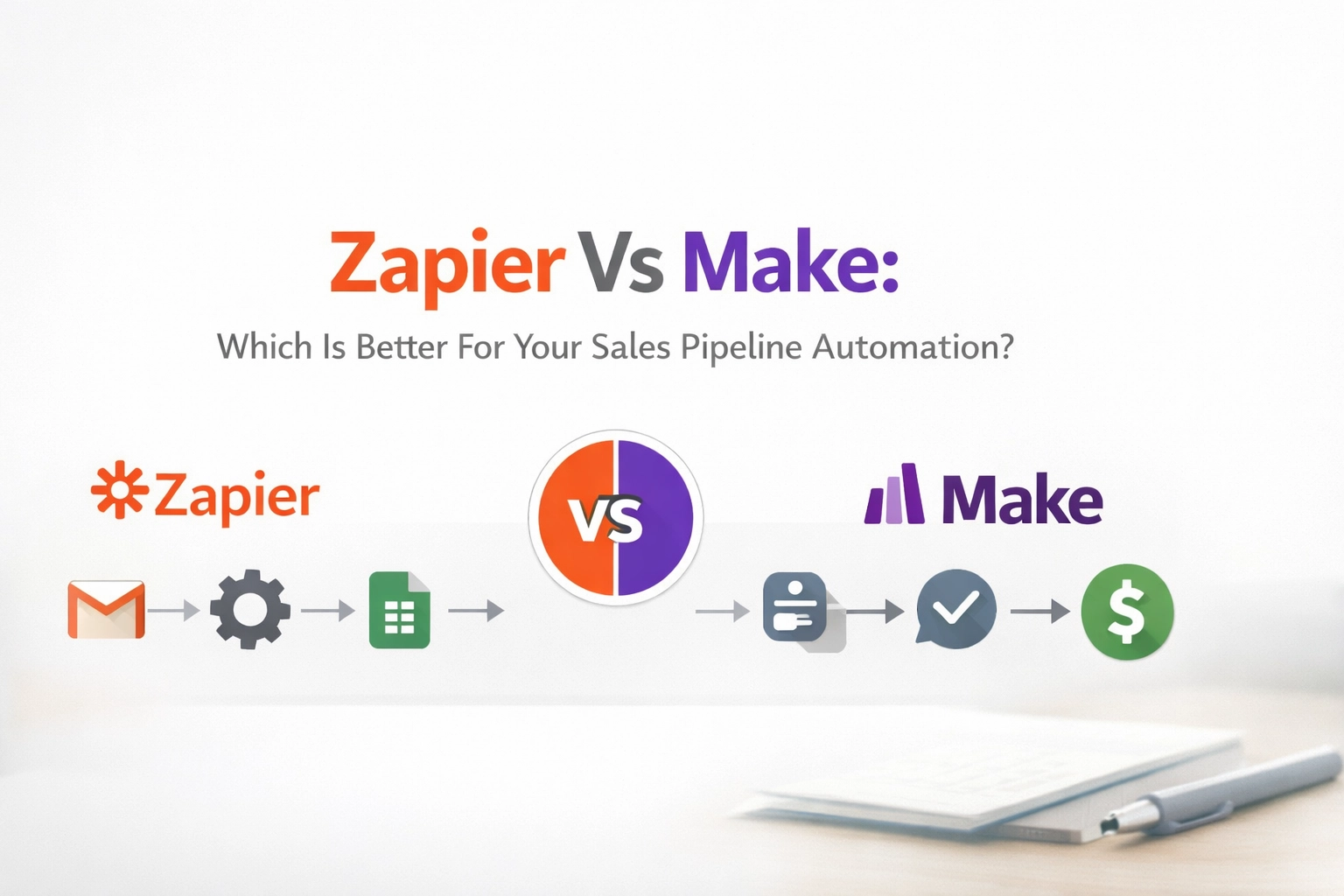
This is where automation platforms like Zapier and Make (formerly Integromat) come in. They are the glue that holds your digital business together. But choosing between them for your sales pipeline can feel like a high-stakes technical decision you don't have time for.
Should you go with the industry giant everyone knows, or the powerful visual tool the "techies" rave about? Let’s break down the Zapier vs. Make debate specifically through the lens of sales pipeline automation.
The Core Philosophy: Simplicity vs. Power
At their heart, both tools do the same thing: they watch for a "trigger" in one app and perform an "action" in another. However, the way they approach this task is fundamentally different.
Zapier is designed for speed and accessibility. Its interface is linear and text-based. You set up a "Zap," and it follows a straight line: if A happens, then do B, then do C. It’s perfect for the solo founder who needs an automation live in five minutes without reading a manual.
Make, on the other hand, is built on a visual canvas. You drag and drop "modules" and connect them with lines, much like a digital whiteboard. This allows for complex branching logic that Zapier often struggles to handle without becoming a messy web of separate automations.

Zapier: The "Easy Button" for Sales Teams
Zapier’s biggest flex is its massive library of integrations. With over 8,000 apps supported, it’s almost guaranteed that every tool in your sales stack, from your cold email software to your niche calendar booking tool, is already on there.
For sales pipeline automation, Zapier shines in "set it and forget it" scenarios. If you want a lead from a Facebook Lead Ad to instantly appear in your HubSpot CRM, Zapier is the undisputed king. The setup is intuitive, and the pre-built templates mean you rarely have to start from scratch.
However, Zapier’s simplicity can sometimes be a bottleneck. If your sales process requires complex "If/Then" logic, like routing a lead to a specific rep based on their industry AND their company size, Zapier can get expensive and clunky. You’ll often find yourself paying for "Multi-step Zaps," which sit behind a higher price tier.
If you’re just starting out and need to stop the manual data leak quickly, Zapier is often the right move. It’s why many founders start there to build their automation for startups.
Make: The Logic Legend for Complex Pipelines
As your startup grows, your sales process naturally becomes more nuanced. You aren't just collecting leads; you’re scoring them, enriching them with data, and routing them through various stages of a sophisticated funnel.
This is where Make takes the lead. Because of its visual nature, you can see the entire journey of a lead on one screen. You can use "Iterators" to loop through a list of items or "Routers" to send data down different paths based on specific filters.
For example, imagine a scenario where a lead fills out a form. In Make, you can:
- Check if the company exists in your Zoho CRM.
- If yes, update the record and notify the account owner.
- If no, create a new company, search for the CEO’s LinkedIn on a third-party tool, and then add them to a "New Prospect" sequence.
Doing this in Zapier would require multiple Zaps and a lot of head-scratching. In Make, it’s one clear visual workflow. This level of control is why we often recommend Make for advanced CRM setup & management.

Let’s Talk Money: The Scaling Problem
One of the biggest differences between these two platforms is the pricing model. This is where many solo founders get a "sticker shock" moment with Zapier.
Zapier charges per "Task." Every time an action is performed, it counts as a task. If you have a high-volume sales pipeline with 5,000 leads a month, and each lead triggers a five-step automation, those tasks add up fast. Your monthly bill can quickly spiral into hundreds of pounds.
Make uses an "Operations" based model, but it is significantly more affordable at scale. You generally get more "bang for your buck" with Make when you are moving large amounts of data. For a lean business looking to keep overheads low, Make is often the more sustainable long-term choice.

Connectivity: HubSpot, Zoho, and the CRM Factor
Your CRM is the heart of your sales pipeline. Whether you use HubSpot, Zoho, or Pipedrive, the depth of the integration matters.
Zapier has a very "deep" integration with major CRMs like HubSpot. It supports custom objects and bulk operations better than almost any other tool. If you are heavily invested in the HubSpot ecosystem, Zapier’s native connector is incredibly robust and reliable.
Make is no slouch, but because it’s a more open-ended platform, you sometimes have to map data fields manually. However, Make gives you access to "API calls" within its modules. This means if a specific CRM feature isn't officially supported in a pre-built module, you can still automate it if you’re willing to get a little technical.
At Nepatech, we help founders navigate these CRM solutions to ensure their chosen automation tool matches their specific sales goals.
Error Handling: When Things Break
In sales, a broken automation means a lost lead. If a lead doesn't sync to your CRM, you might not follow up for days. By then, the prospect is cold.
Make has superior error handling. You can create "Directives" that tell the system exactly what to do if a step fails: like retrying the action or sending the data to a "fallback" spreadsheet. This ensures that no lead ever truly disappears into the void.
Zapier does have "Autoreplay," but it’s generally less customizable. It will try again, but it doesn't give you the same level of control over the recovery process that Make provides.

Which One Should You Choose?
So, who wins the Zapier vs. Make battle for sales pipeline automation? The answer depends on your stage of business and your technical comfort level.
Choose Zapier if:
- You need to get moving today.
- You have a simple, linear sales process (Lead -> CRM -> Email).
- You use niche apps that only Zapier supports.
- You prefer a "no-code" experience that feels like using a standard web app.
- Check out how we support smart automation for startups to see if this fits your model.
Choose Make if:
- You have complex, branching sales logic.
- You are processing a high volume of leads and want to keep costs down.
- You want a visual overview of your entire business logic.
- You aren't afraid of a slightly steeper learning curve in exchange for total control.
The Hybrid Approach
Many of the founders we work with actually use both. They might use Zapier for a quick-fire integration with a new marketing tool, but build their core, "heavy-lifting" sales pipeline in Make.
The most important thing isn't the tool itself; it's the strategy behind it. If your pipeline is messy and your data is unorganized, automating it will just create a "faster mess."
Before you pick a platform, make sure your sales SOPs (Standard Operating Procedures) are documented. Know exactly what should happen when a lead enters your world. Once the logic is sound, the automation part becomes a lot easier.

How Nepatech Solutions Can Help
Building these bridges between your sales tools is what we do every day. Whether you need a full CRM setup or you want to hand off the technical headache to a virtual assistant, we’re here to help you scale smarter.
We specialize in taking the manual work off your plate so you can focus on the big picture. If you’re tired of fighting with API keys and "Zap errors," let’s talk.
- Ready to automate? Request a free quote and let's look at your pipeline.
- Not sure where to start? Check out our services page to see how we help solo founders stay lean.
- Need more advice? Browse our blog for more tips on digital business support.
In the world of sales, speed is everything. Following up within five minutes can double your conversion rate. Whether you use Zapier or Make, the goal is the same: get to the prospect faster, more efficiently, and with less stress.
Stop being the middleman in your own business. It’s time to automate.